Why Releasing Your Jaw Can Instantly Improve Your Breathing, Posture, and Core
Why Releasing Your Jaw Can Instantly Improve Your Breathing, Posture, and Core
The overlooked connection between jaw tension, shallow breathing, and whole-body imbalance
Most people don’t realize this, but the tension you’re holding in your jaw may be quietly affecting your entire body.
That clenched jaw you barely notice throughout the day is not just a stress habit. It can literally compress your breathing, destabilize your core, and slowly pull your posture out of alignment from the inside out.
This is why, in Somalates and Pilates, I cue jaw relaxation just as intentionally as I cue breath or pelvic floor. Because everything is connected.
The Jaw Is Not an Isolated Muscle
Your jaw muscle, called the masseter, is one of the strongest muscles in the body. What most people don’t know is that it shares deep connections with your diaphragm and pelvic floor through the nervous system and fascial chains.
Think of these areas as being on the same internal communication line. When one is tight, the others respond.
So when your jaw is clenched, your body interprets that as stress.
What Happens When You Clench Your Jaw
In simple terms, here’s the chain reaction:
• Your diaphragm cannot fully expand, which means your breath stays shallow and oxygen intake drops
• Your pelvic floor tightens to compensate, creating tension in the hips and lower back
• Your core becomes rigid instead of responsive
• Your posture collapses forward as your body looks for stability elsewhere
This creates a domino effect:
Tight jaw → shallow breathing → weak, rigid core → poor posture
Over time, this can show up as neck pain, lower back discomfort, pelvic floor dysfunction, anxiety, fatigue, and that familiar hunched, compressed posture so many of us live in.
The Science (Without the Overwhelm)
Here’s the simplified version of what’s happening neurologically:
The trigeminal nerve (which controls the jaw) communicates with the vagus nerve (which influences the diaphragm and nervous system calming response). This then affects the pelvic nerves, which help regulate pelvic floor tone and stability.
When the jaw stays clenched… the diaphragm stays lifted instead of dropping fully, the pelvis tips forward, the spine compresses and the body stays stuck in low-grade “fight or flight”
When the jaw relaxes… the diaphragm drops and breath deepens, the pelvis stabilises… the spine lengthens naturally and the nervous system shifts toward calm and balance.
This is posture from the inside out.
Why “Fixing Your Posture” Rarely Works
Most people try to correct posture by pulling their shoulders back or bracing their core.
That’s like trying to fix a cracked foundation by repainting the walls.
If the jaw is tense and the breath is shallow, the body cannot organize itself properly, no matter how many posture cues you give it.
True alignment starts with release, not force.
How Somalates® and Pilates Help
In Somalates® and Pilates, we don’t just train muscles. We retrain communication.
That’s why I cue:
• Jaw softening
• Tongue relaxation
• Breath depth
• Pelvic floor responsiveness rather than gripping
When the jaw releases, the breath naturally deepens.
When the breath deepens, the pelvic floor stops overworking.
When the pelvic floor balances, the core becomes supportive instead of stiff.
This is how posture improves without strain and this is how the body feels lighter, taller, and more at ease.
Why I Cue Jaw Relaxation in Class
Because you cannot separate posture from breathing, you cannot separate breathing from the nervous system, and you cannot separate the nervous system from how safe your body feels.
Releasing jaw tension is not a small thing, it is one of the fastest ways to restore balance to the entire system.
So next time you catch yourself clenching, pause.
Soften the jaw let the tongue rest and take a slow breath in.
Your posture, your core, and your nervous system will thank you.
This is not about doing more.
It’s about allowing the body to remember how to work together again.
If you’d like more details about the classes then get in touch for in person and online options: here
📩 Join The Refuel Newsletter
If you’d like tips, support and a weekly Pitstop to refuel, delivered without noise or trends… join The Refuel.
Each week, I share practical tools to help you move well, recover better, and support your body through change.
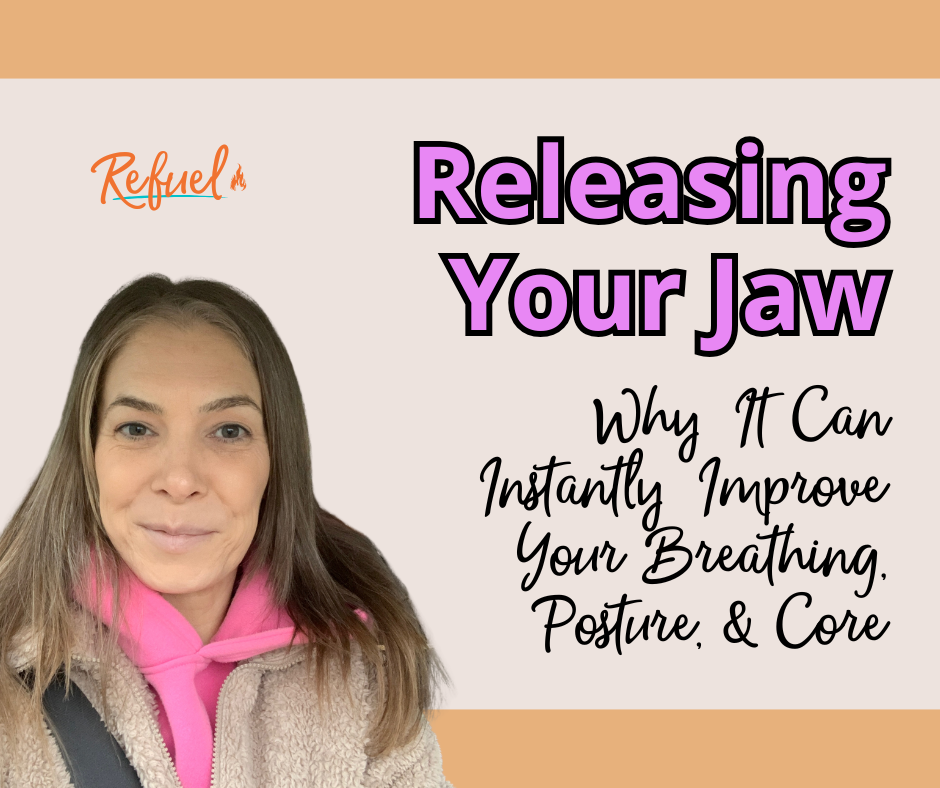
Tracy Richardson MSc is a movement and wellness specialist with a background in therapy, Pilates, and wellbeing, she combines evidence-based practice with a nurturing, mindful approach. Tracy’s mission is to empower individuals to move with awareness, release tension, and cultivate sustainable health, strength, and inner calm. When she’s not teaching or writing, you’ll often find her walking her dog, practising Pilates, or sipping a calming cup of tea.
