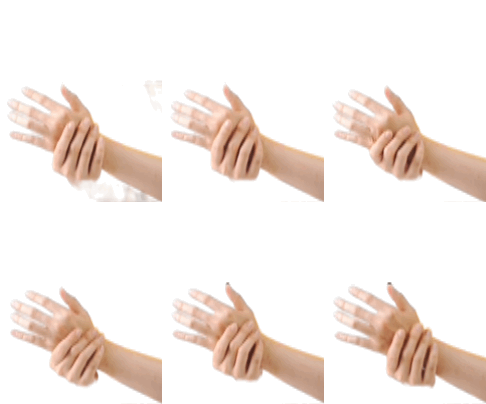

Why Women Struggle With Wrist Pain… And What We Can Do About It
By Tracy Richardson MSc
In almost every class I teach, there’s at least one woman quietly shaking out her hands, wincing during weight-bearing, or avoiding certain moves altogether.
And if that’s you, please hear this: It’s not because you’re “weak.” It’s because your wrists are asking for support, not strain.
Wrist pain is incredibly common for women in midlife and beyond. These small joints are doing huge amounts of work, and when we layer hormonal change, reduced muscle mass and daily-life overload on top, they simply run out of capacity.
Let me break down what I see most often in clinic and class…
The Most Common Wrist Issues I See
1. Tendon Irritation (Tendinopathy)
From gripping, lifting, typing, or weight-bearing.
Feels like:
– Aching on the top or thumb side of the wrist
– Pain with lifting, twisting or pushing
– Weak grip
2. Carpal Tunnel Syndrome
Pressure on the median nerve.
Feels like:
– Tingling or numbness in thumb, index + middle finger
– Weakness
– Night-time symptoms
3. De Quervain’s Tenosynovitis
Thumb tendons irritated.
Feels like:
– Sharp pain when gripping
– Pain radiating up the forearm
– Difficulty lifting a kettle or weights
4. Joint Stiffness / Arthritis
Particularly common post-45.
Feels like:
– Morning stiffness
– Aching after weight-bearing
– Reduced mobility
Why This Peaks Around Menopause
This is where my MSc work in exercise and women’s health comes in:
• Lower oestrogen means tendons lose elasticity so they become irritated more easily.
• Muscle mass naturally declines so if shoulders + forearms aren’t strong enough, the wrists carry the load.
• Posture changes from desk work
Rounded shoulders → compressed wrists → more strain.
• Increased inflammation
A normal part of the hormonal transition, but tough on joints.
None of this is “in your head.” Your body is adapting and it needs smart support, not more force.
What Wrist Pain Typically Feels Like
✔ Aching or burning
✔ Sharp pain when pressing into hands
✔ Weak grip
✔ Clicking or grinding
✔ Pain during planks, push-ups or Pilates weight-bearing
If you recognise these, you’re in good company. And there is a way forward.
How Pilates Helps (When It’s Taught Well)
This is where my coaching becomes very intentional:
1. We strengthen shoulders + upper back
Take pressure off the wrists by building the support system above them.
2. We improve load distribution
Learning to use the whole hand changes everything.
3. We always offer alternatives
Fists, forearms, blocks -as-handles, you never have to push through pain.
4. We mobilise gently
Small, well-timed mobility reduces stiffness and improves confidence.
5. We strengthen forearms + grip safely
Essential for tendon health, especially in midlife.
This is exercise that meets your physiology, not fights it.
Wrist-Friendly Strength Work You’ll See in My Classes
1. Wrist Circles
Loose fist → slow circles.
10–15 each way.
Wakes up the joint and tendons.
2. Flexion + Extension Strengthening
10–12 reps each direction.
Builds the scaffolding that protects the wrist.
3. Gentle Grip Work
Soft ball or towel.
Improves tendon resilience for daily tasks.
4. Spider-Man hands- Finger Extensions
Spreading fingers wide.
Balances the gripping muscles.
5. Wall Press
A brilliant early-stage option.
Loads the wrist without overwhelming it.
6. All Fours Mobilisation
Hands flat and gently shifting weight
Drop back into hips to reduce load.
7. Isometric Holds
Palms pressed together.
Strength without movement- great in flare-ups.
Helpful Habits We Build Into Class
✔ Strong shoulders → happy wrists
✔ Active hand placement
✔ Alternative positions without apology
✔ Gentle warm-ups before loading
✔ Soft elbows to avoid dumping weight into the joint
You don’t need to “push through.”
You need movement that respects the stage of life you’re in.
If Wrist Pain Has Been Limiting You, Come Join Me
You’ll learn how to move in ways your wrists can tolerate, while strengthening the areas that have been quietly under-working for years.
You’ll be supported.
You’ll build confidence.
You’ll feel capable again.
And you’ll realise that wrist pain doesn’t have to be the thing that stops you, not in Pilates, and not in your everyday life.
Come take a class.
Let’s rebuild strength where it matters most.