

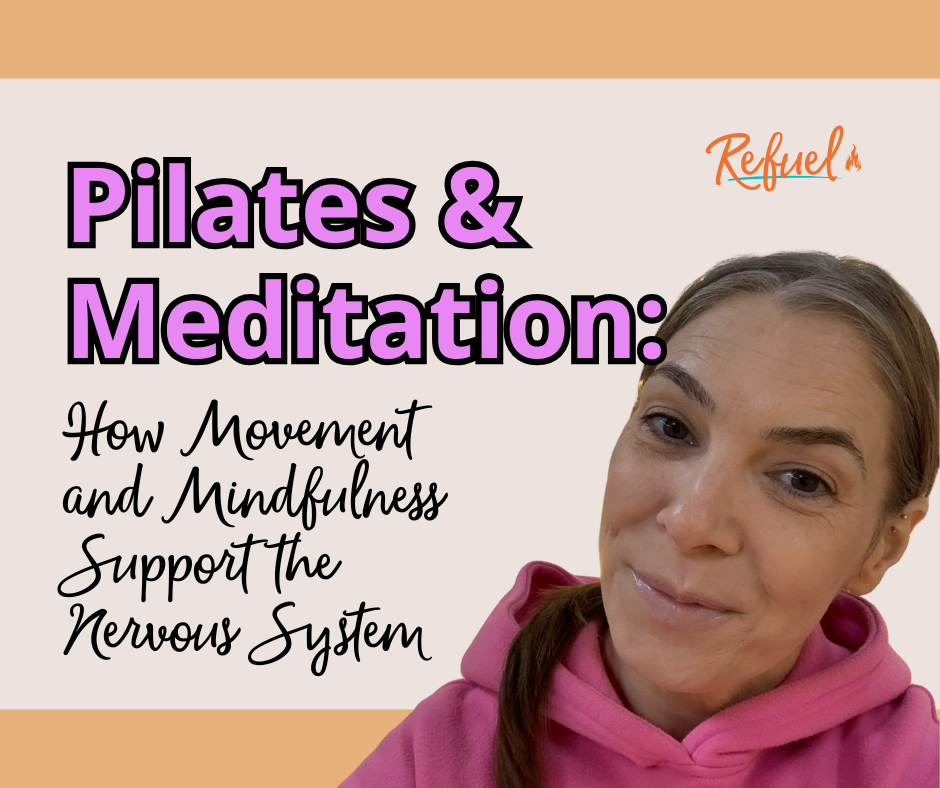
Pilates and Meditation: How Movement and Mindfulness Support the Nervous System
Why combining Pilates and meditation supports regulation, recovery, and resilience, especially in midlife
Meditation and Pilates are often viewed as separate practices, one for the mind, one for the body. In reality, both work through the same underlying system: the nervous system.
For women in midlife especially, the way the nervous system processes stress, movement, and recovery changes. Hormonal shifts influence cortisol regulation, sleep quality, emotional resilience, and muscular tone. This is why practices that support regulation rather than stimulation become increasingly important.
When Pilates and meditation are understood correctly, they are not additional demands on the body. They are tools for integration.
Pilates as a Moving Meditation
At its core, Pilates is not a fitness class, it is a neuromuscular practice.
Every element of Pilates requires:
Focused attention
Breath awareness
Precision of movement
Sensory feedback from the body
This places Pilates firmly within the category of embodied mindfulness. The nervous system is constantly receiving and responding to information: joint position, muscle tension, breath rhythm, balance, and load.
For many women, particularly those who find traditional seated meditation challenging, Pilates becomes a more accessible entry point into meditative awareness. The body provides an anchor. Attention has somewhere to land.
Meditation and the Nervous System
Meditation works primarily by shifting the nervous system from a sympathetic (fight-or-flight) state into a parasympathetic (rest-and-digest) state.
Benefits include:
Reduced stress reactivity
Improved emotional regulation
Enhanced sleep quality
Greater interoceptive awareness
However, for individuals who are already highly stressed or dysregulated, stillness can initially feel uncomfortable. The nervous system may perceive silence as unsafe.
This is where movement-based practices like Pilates offer a bridge.
Why Pilates and Meditation Work Better Together
When combined, Pilates and meditation create a feedback loop between movement and stillness.
Pilates:
Improves body awareness
Regulates muscle tone
Enhances breath control
Builds confidence in physical capacity
Meditation:
Consolidates nervous system calm
Improves focus and emotional resilience
Enhances recovery and sleep
Reduces cognitive load
Together, they support nervous system adaptability, the ability to move between activation and rest with ease.
For women navigating perimenopause and menopause, this adaptability is essential.
Breath: The Shared Language
Both Pilates and meditation are anchored in breath, not as a technique to be forced, but as a regulatory signal.
Breath influences:
Heart rate variability
Vagal tone
Core muscle coordination
Emotional state
In Pilates, breath supports movement efficiency and spinal stability. In meditation, breath anchors attention and downregulates stress responses.
When breath awareness carries from the mat into stillness, the nervous system learns continuity rather than contrast.
It’s Not About Doing More
A common misconception is that adding meditation to Pilates means adding another task to an already full schedule.
In reality, it is about refining attention, not increasing effort.
This may look like:
A brief pause at the end of class
A few minutes of breath awareness before movement
Noticing sensation rather than performance
Allowing stillness after exertion
Small moments of integration are often more effective than long, isolated practices.
The Takeaway
Pilates and meditation are not opposites. They are complementary expressions of the same goal: nervous system regulation through awareness.
For women in midlife, this combination supports:
Emotional resilience
Improved movement quality
Better recovery and sleep
A more responsive, less reactive body
Pilates teaches the body to listen.
Meditation teaches the mind to stay.
Together, they create a practice that supports not just how we move, but how we live.
📩 Join The Refuel Newsletter
If you’d like tips, support and a weekly Pitstop to refuel, delivered without noise or trends… join The Refuel.
Each week, I share practical tools to help you move well, recover better, and support your body through change.
Tracy Richardson MSc is a movement and wellness specialist with a background in therapy, Pilates, and wellbeing, she combines evidence-based practice with a nurturing, mindful approach. Tracy’s mission is to empower individuals to move with awareness, release tension, and cultivate sustainable health, strength, and inner calm. When she’s not teaching or writing, you’ll often find her walking her dog, practising Pilates, or sipping a calming cup of tea.
