

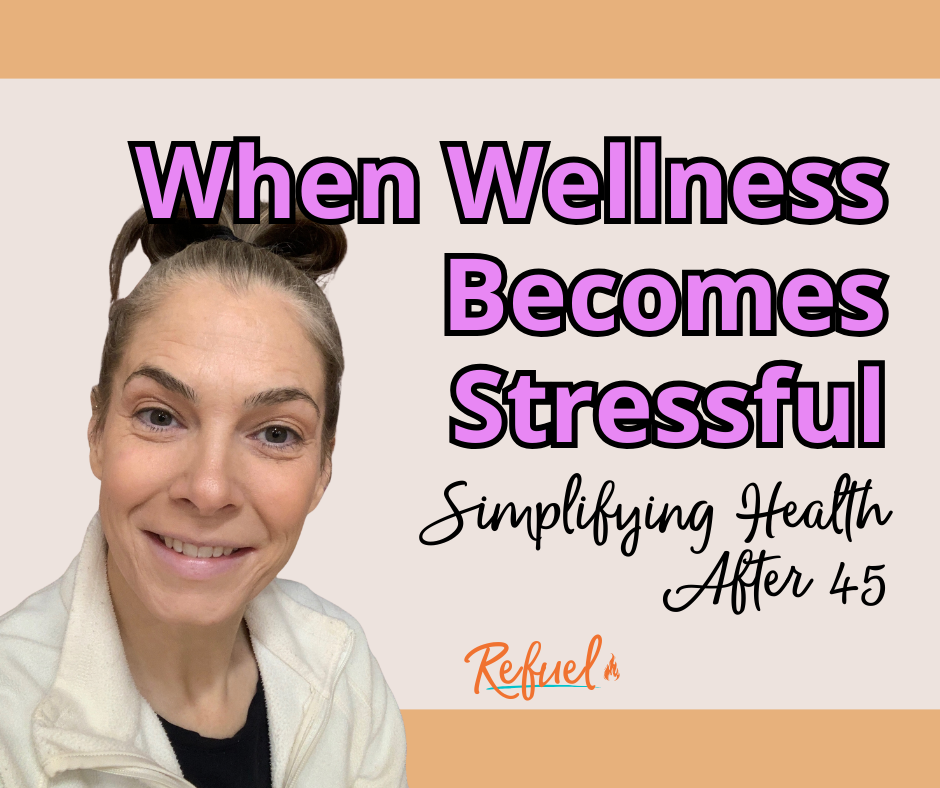
When Wellness Becomes Stressful: Simplifying Health After 45
Wellness was supposed to make us feel better.
Yet many women arrive in midlife feeling more overwhelmed than ever juggling advice, tracking habits, fixing perceived flaws, and constantly wondering if they’re doing enough.
Track this.
Fix that.
Add more.
Somewhere along the way, wellbeing became another full-time job.
Why “More” Stops Working After 45
In our earlier years, the body often tolerates complexity. We can stack workouts, restrict food, push through fatigue, and recover relatively quickly.
After 45, that tolerance changes.
Hormonal shifts make the nervous system more sensitive to stress. Recovery slows. Sleep becomes lighter. And the margin for error shrinks.
The body no longer thrives on constant input.
It thrives on consistency and calm.
When too many demands are placed on the system even “healthy” ones the nervous system can become dysregulated. Stress hormones rise. Energy dips. And despite doing everything right, you feel tired, tense, or flat.
The Hidden Stress of “Doing Wellness Well”
One of the most overlooked stressors in midlife is the pressure to optimise health.
Supplements to remember.
Workouts to schedule.
Rules to follow.
Metrics to track.
This constant decision-making creates cognitive and physiological load especially for women already managing busy lives.
Ironically, the pursuit of wellbeing can begin to undermine it.
Subtraction as Support
Sometimes the most supportive thing you can do is not add another practice but remove what’s unnecessary.
This doesn’t mean giving up on health.
It means choosing what truly supports your body now.
For many women, this looks like:
A few regular Pilates sessions
Daily walking at an unhurried pace
Eating enough, consistently
Prioritising rest and sleep
These are not shortcuts.
They are foundations.
Why Simplicity Works
Simplicity allows the nervous system to settle.
When routines are predictable and supportive, the body feels safer. Stress hormones lower. Energy becomes more stable. Movement feels easier.
Pilates works so well in midlife because it’s focused and intentional it strengthens without overwhelming. Walking supports circulation and calm without depletion. Adequate nourishment and rest provide the raw materials the body needs to adapt.
None of this is flashy.
All of it works.
Letting Go of the Optimisation Mindset
Wellness culture often promotes optimisation the idea that there is always a better version of yourself to unlock.
But health in midlife isn’t about becoming something else.
It’s about coming back into alignment with your body.
Alignment looks like:
Listening rather than overriding
Adjusting rather than forcing
Choosing steadiness over extremes
When alignment is restored, many symptoms begin to ease not because you tried harder, but because you stopped fighting your biology.
The Takeaway
Wellbeing doesn’t come from doing more.
It comes from doing what matters consistently, calmly, and with care.
After 45, health is less about optimisation and more about alignment. When you simplify, the body responds. Energy returns. Movement feels supportive again. And wellbeing becomes something you live not something you chase.
📩 Join The Refuel Newsletter
If you’d like tips, support and a weekly Pitstop to refuel, delivered without noise or trends… join The Refuel.
Each week, I share practical tools to help you move well, recover better, and support your body through change.
Tracy Richardson MSc is a movement and wellness specialist with a background in therapy, Pilates, and wellbeing, she combines evidence-based practice with a nurturing, mindful approach. Tracy’s mission is to empower individuals to move with awareness, release tension, and cultivate sustainable health, strength, and inner calm. When she’s not teaching or writing, you’ll often find her walking her dog, practising Pilates, or sipping a calming cup of tea.
