

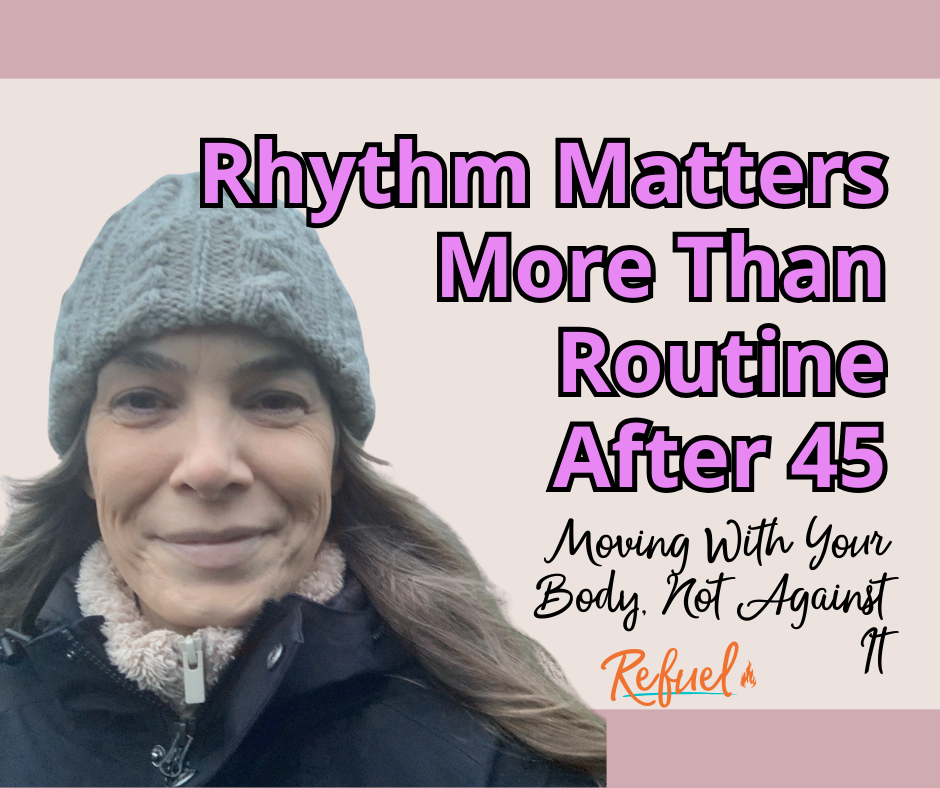
Why Rhythm Matters More Than Routine After 45: Moving With Your Body, Not Against It
Rigid routines work well, until they don’t.
For many women, there comes a point in midlife when following the same plan, week after week, starts to feel heavy rather than supportive. What once felt motivating begins to feel exhausting. Miss a session and guilt creeps in. Push through and recovery lags behind.
This isn’t a lack of discipline.
It’s a mismatch between how the body works now and how we’ve been taught to train.
Midlife Bodies Are Not Linear
Midlife bodies are cyclical, responsive, and far more sensitive to stress.
Hormonal changes affect energy, sleep, mood, and recovery. Life demands fluctuate. Some weeks feel strong and capable. Others feel slower, quieter, or more inward.
Trying to apply the same intensity, volume, or expectation every single week ignores this reality and often leads to frustration or burnout.
The body isn’t inconsistent.
It’s responsive.
The Problem With Rigid Routines
Rigid routines assume the body operates like a machine: same input, same output.
But after 45, that model stops working.
When routines don’t allow for adjustment, they can:
Increase nervous system stress
Delay recovery
Trigger guilt when energy dips
Create an all-or-nothing mindset
The result isn’t better consistency, it’s resistance.
Rhythm: A More Supportive Way Forward
Rhythm is different from routine.
Rhythm allows for ebb and flow. It recognises that energy isn’t fixed and that movement should respond to what’s happening in your body and life.
In a rhythmic approach:
Some days focus on strength
Others prioritise mobility or rest
Walking might feel energising one week and restorative the next
Pilates sessions adapt to how the body arrives
This flexibility doesn’t weaken results.
It sustains them.
How Pilates Fits Into a Rhythmic Approach
Pilates is uniquely suited to rhythm because it’s adaptable by design.
It can be:
Strong and dynamic
Slow and restorative
Focused on stability, mobility, or breath
This makes it ideal for midlife bodies that need support rather than pressure.
Instead of forcing consistency through intensity, Pilates builds it through responsiveness.
Rhythm Builds Trust, Not Guilt
One of the greatest benefits of moving with rhythm is psychological.
When movement adapts to your body:
Guilt disappears
Missed sessions lose their emotional charge
Confidence returns
Consistency becomes natural
You stop negotiating with yourself and start working with yourself.
That’s where sustainable wellbeing lives.
Redefining Consistency After 45
Consistency isn’t doing the same thing every week.
It’s staying in relationship with your body even when that relationship changes.
Some weeks that looks like more movement.
Some weeks it looks like more rest.
Both are part of the rhythm.
The Takeaway
After 45, your body doesn’t need stricter routines.
It needs rhythm.
When you honour natural fluctuations in energy, stress, and capacity, movement becomes easier to maintain. Walking, Pilates, and rest shift in emphasis without judgement or guilt.
Rhythm doesn’t weaken your results.
It protects them.
And in midlife, protection is power.
📩 Join The Refuel Newsletter
If you’d like tips, support and a weekly Pitstop to refuel, delivered without noise or trends… join The Refuel.
Each week, I share practical tools to help you move well, recover better, and support your body through change.
Tracy Richardson MSc is a movement and wellness specialist with a background in therapy, Pilates, and wellbeing, she combines evidence-based practice with a nurturing, mindful approach. Tracy’s mission is to empower individuals to move with awareness, release tension, and cultivate sustainable health, strength, and inner calm. When she’s not teaching or writing, you’ll often find her walking her dog, practising Pilates, or sipping a calming cup of tea.
